Finding the right B2B digital marketing company in India can be harder than it seems. Many agencies offer similar services and make similar promises about traffic, visibility, and leads. The real challenge is finding a team that understands your business, reaches the right decision-makers, and supports your sales goals.
B2B buying decisions rarely happen overnight. A potential client may visit your website, compare competitors, read your content, check your reputation, and discuss the purchase with other people before making a decision. That is why choosing an agency should not be based only on its service list. Look for a partner that understands your industry, audience, sales cycle, and business goals.
If you are searching for a B2B digital marketing company in India, this guide explains what to look for, which services matter, what affects pricing, and how to decide whether an agency is the right fit.
A B2B digital marketing company helps businesses attract and convert other businesses through online channels. That can include search engines, paid advertising, websites, content, email, social media, analytics, and other digital platforms. But good B2B marketing is more than putting a business in front of as many people as possible. The goal is to reach the right people at the right stage of their buying journey.
For example, a business selling enterprise software may need to reach a business owner, marketing manager, IT team, finance department, and procurement team. Each person may have different questions before the company is ready to buy. A strong B2B strategy takes this into account.
B2C purchases can sometimes happen within minutes. A customer sees a product, likes it, checks the price, and buys it. B2B decisions usually take longer. There may be multiple decision-makers, larger budgets, internal approvals, product demonstrations, proposals, and negotiations. Because of this, B2B marketing needs to build trust over time.
The content also needs to answer more detailed questions. A potential customer may want to know about pricing, implementation, integrations, security, support, results, and whether the solution fits their business.
B2C purchases can sometimes happen within minutes. A customer sees a product, likes it, checks the price, and buys it. B2B decisions usually take longer. There may be multiple decision-makers, larger budgets, internal approvals, product demonstrations, proposals, and negotiations. Because of this, B2B marketing needs to build trust over time.
The content also needs to answer more detailed questions. A potential customer may want to know about pricing, implementation, integrations, security, support, results, and whether the solution fits their business.
The main goal should not simply be more website visitors.
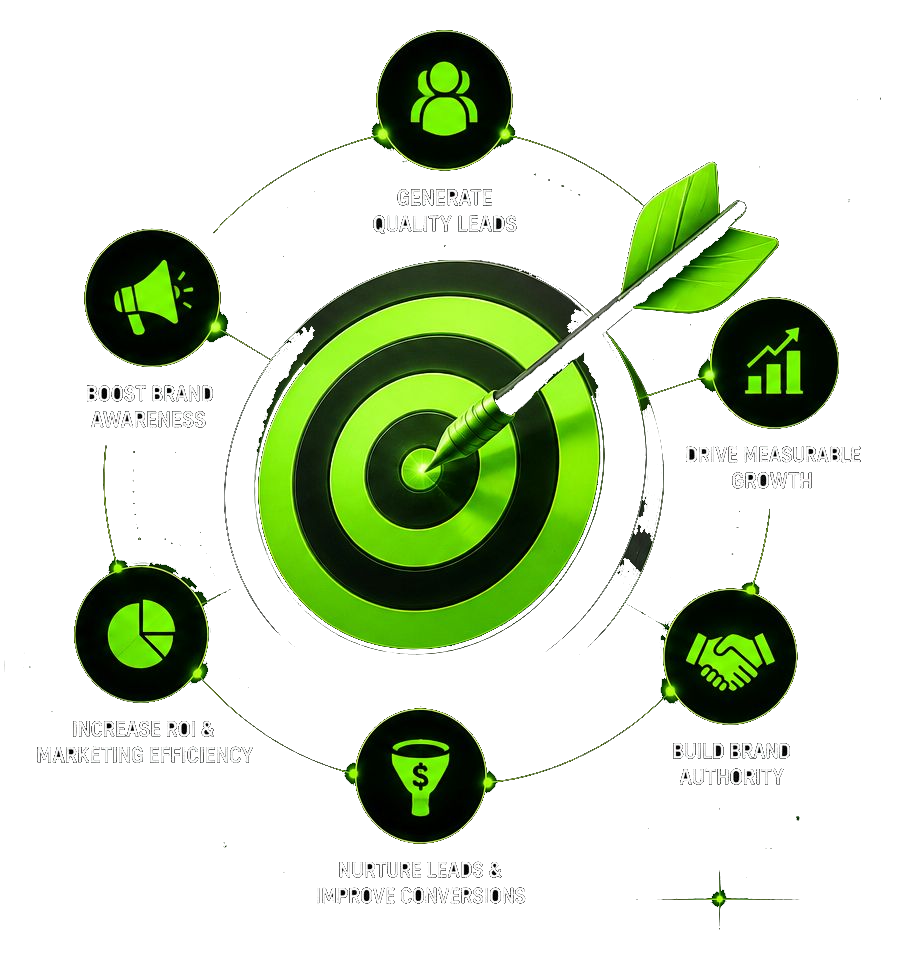
A useful B2B strategy should work toward:
The digital marketing industry is crowded. Almost every agency offers SEO, social media, paid advertising, content, or website development. The problem is that the same services can produce very different results depending on how they are planned and executed.
A business may hire an agency and see website traffic increase, but the sales team may still receive very few useful inquiries. Another company may generate hundreds of leads, only to discover that most are not relevant to its target market. This usually happens when marketing activity is treated as the goal instead of the means.
Some common problems businesses face include:
From our experience working on different digital projects, these problems are often connected. A website may need improvement before paid campaigns can perform well, or better conversion tracking may be needed before a business can see which channels are bringing useful inquiries.
A good agency should be able to explain why it recommends a strategy, what it should achieve, and how the results will be tracked.
Lorem ipsum dolor sit amet, consectetur An agency should understand that B2B customers do not all think alike. A software buyer has different concerns from a manufacturer, healthcare provider, real estate company, or professional service firm. The strategy should reflect the business, its audience, sales cycle, and market.
At MKR Techsoft, we know that every B2B business is different. What works for a technology company may not work for a healthcare, real estate, or professional services business. That is why we first understand the business, its audience, and its goals before choosing the right approach.
More leads are not always better. If your sales team spends its time filtering irrelevant inquiries, the marketing campaign is not doing its job properly. A good agency should understand what a qualified lead means for your business and build campaigns around that definition.
B2B buyers often research a problem long before contacting a company. That makes SEO and useful content important parts of the buying journey. Your website should answer the questions potential customers are already asking rather than simply filling pages with keywords.
Getting visitors to your website is only one part of the process. If the website is slow, confusing, difficult to navigate, or unclear about what the visitor should do next, valuable traffic can be wasted.
A good agency should help you understand what is working. Depending on the campaign, useful measurements can include organic traffic, conversion rates, qualified inquiries, cost per lead, campaign performance, and other business-specific metrics.
Search is changing. People increasingly use AI-powered tools alongside traditional search engines when researching products, services, and businesses. B2B content therefore needs to be clear, useful, well structured, and based on real questions. Optimizing for search should not mean writing only for algorithms.
A B2B company rarely needs one isolated marketing activity. Different channels often work together throughout the customer journey.
Service
Service
What It Can Include
SEO
Helps potential customers find your business when they search for relevant solutions
Technical SEO, keyword research, on-page SEO and content strategy
Content Marketing
Helps buyers understand your services and make informed decisions
Blogs, service pages, case studies, guides and other useful content
Google Ads & PPC
Helps reach people who are already looking for relevant products or services
LinkedIn & Social Media
Helps businesses share their expertise and stay visible to potential buyers
Industry insights, educational content, company updates and social campaigns
Gives visitors a clear way to understand your business and take the next step
Website development, e-commerce, landing pages and user experience
AI Automation & Digital Transformation
Helps businesses reduce manual work and improve everyday processes
Technology & Integrations
Helps different tools and systems work together more effectively
APIs, integrations, platforms and business systems
UI/UX & Creative Design
Makes digital experiences easier to use and presents the business clearly
UI/UX, landing page design, creative assets and visual content
Analytics & Conversion Tracking
Shows what visitors do and which marketing activities generate inquiries
Website analytics, conversion tracking, lead data and reporting
AI Search, AEO & GEO
Helps useful business information become easier for search and AI platforms to understand
Structured content, direct answers, topical relevance and AI-focused optimization
SEO can help businesses become visible when potential customers search for solutions. A strong strategy may include:
Good content helps potential customers understand a problem and evaluate possible solutions.
This can include:
Paid search can help businesses reach people who are already searching for relevant products or services. A B2B PPC strategy may include high-intent keywords, campaign segmentation, landing pages, conversion tracking, remarketing, and ongoing optimization. The goal should be to bring the right visitors to the right page rather than simply increasing clicks.
B2B companies often need to build credibility before a prospect is ready to speak with sales. Social media can support this by sharing useful insights, company expertise, customer stories, educational content, and industry information.
Analytics helps businesses see what happens after someone reaches the website. Instead of asking only, “How many people visited?”, businesses can start asking better questions:
Which pages generate inquiries? Which campaigns bring qualified visitors? Where are potential customers dropping off? Which channels are producing useful opportunities?
These answers make marketing decisions much easier.
Traditional SEO is still important, but search behavior is expanding. People may now use Google, AI-powered search, ChatGPT, Perplexity, Gemini, and other platforms during their research. AEO and GEO focus on making useful content easier for AI tools to understand and use. This starts with the basics: accurate information, clear structure, helpful answers, strong topical relevance, and content written for real users.
Ask whether the agency has worked with businesses similar to yours. Relevant experience can help an agency understand your customers, competitors, terminology, and sales process faster.
Rankings and traffic are useful indicators, but they are not the whole picture. Ask how the agency measures:
The right metrics depend on your business, but they should connect marketing activity to something meaningful.
If an agency is responsible for improving your digital presence, take a close look at its own. Is the website easy to understand? Can you find its services? Does the content answer your questions? Is the company active and credible online?
It will not tell you everything, but it can give you useful clues.
During the sales process, you may speak with a senior person. That does not necessarily mean that person will manage your project. Ask who will handle your account, who develops the strategy, who creates the content, and who reports on performance.
A good agency should be able to explain what happens after you start working together. The first few months may include discovery, audits, research, strategy development, technical improvements, campaign setup, content planning, and initial testing. Be cautious of anyone promising dramatic results without first understanding your business.
India has a large pool of professionals across digital marketing, technology, content, development, and creative services. This allows businesses to access different skills while working with an India-based team. For international businesses, working with an Indian B2B agency can also provide access to specialized skills and flexible engagement options.
Cost can be another factor, but it should not be the only reason to choose an agency. Businesses should also consider the team’s expertise, communication, industry experience, and ability to understand their goals. The right agency should offer a practical balance of skills, communication, service quality, and value.
No credible agency can guarantee a specific ranking, number of leads, or revenue figure because results depend on competition, industry, budget, website quality, offer, market, and many other factors. What you can expect is a clear strategy and measurable progress.
Depending on your starting point and goals, this may include:
There is no single price for B2B digital marketing. The cost depends on what your business actually needs. An SEO-focused engagement will have different requirements from a full-service campaign covering SEO, paid advertising, content, website development, social media, analytics, and automation.
Pricing can also be affected by:
Before making a decision, ask the agency a few straightforward questions:
The best agency depends on your industry, goals, target market, budget, and required services.
Pricing varies based on services, campaign scope, competition, target market, and level of support.
SEO usually takes several months, while paid campaigns can generate data and inquiries sooner.
Yes. Many Indian agencies work remotely with international businesses across different time zones and markets.
Common services include SEO, paid advertising, content, website development, social media, analytics, email marketing, and conversion optimization.
Compare relevant experience, services, case studies, communication, reporting, and understanding of your sales process.
It depends on the business, budget, competition, and urgency, and many companies benefit from using both strategically.
Ask about relevant experience, strategy, reporting, the assigned team, timelines, pricing, and how success will be measured.
Yes. Many full-service agencies combine marketing with website, UI/UX, conversion, and technical services.
B2B buying usually involves longer sales cycles, higher-value decisions, and multiple stakeholders.